
Agencies probing the 26/11 case will seek voice samples of David Headley and Tahawwur Rana -- the terror suspects -- from the Federal Bureau of Investigation to ascertain the duo's role in the Mumbai terror attacks.
Seeking to downplay the inability of Indian officials to get access to suspected terrorist David Headley, the government on Tuesday said it has received a full report from US investigators and has advised them on what lines further probe was required.
'In the long run, because of international pressure, Headley's testimony will become credible in Pakistan also. And if Pakistan decides to examine him as a witness in their trial then I think there is a chance of conviction against Hafiz Saeed and Zaki-ur Rehman Lakhvi.'
"If there are other offences, which are not covered under the plea agreement, then of course extradition is still possible," Home Secretary G K Pillai said when asked about chances of India being able to get Headley's extradition.
The United States did not provide information to India on David Headley before 26/11, as intelligence inputs it had about the Mumbai terror plotter was not enough to sufficiently establish his role in planning terrorist attack there, America's spy chief has said.
A team of the National Investigation Agency is probing whether Pakistani born American citizen and Lashkar-e-Tayiba operative David Coleman Headley visited Ajmer after the terror attack on Mumbai last year. Headley was arrested by the Federal Bureau of Investigation in early October from Chicago on charges of plotting terror attacks in India and Denmark. The NIA team has already searched a number of hotels in Pushkar, 15 kms from Ajmer, and taken possession of the records

However, the Pakistani-American LeT commander Zakiur Rehman Lakhvi stopped him, saying something more "adventurous" was in store for him.

In a significant claim, Pakistani-American terrorist David Coleman Headley on Thursday said that Ishrat Jahan -- who was killed in an alleged fake encounter in 2004 in Gujarat --was actually a suicide bomber of Lashkar-e-Tayiba terror outfit.
The Federal Bureau of Investigation has politely turned down India's request for extradition of terror suspect David Headley to India on the ground he will have to first undergo a sentence which could be imposed on him in the US for the offences committed if convicted.
India said it was awaiting further information from the US with regard to probe against suspected Lashkar operatives David Coleman Headley and Tahawwur Rana arrested in Chicago in October. The FBI revealed to India two weeks ago that the LeT were linked to the Mumbai attacks.
Investigators say David Headley may have surveyed 26/11 targets and guided the terrorists's minders in Pakistan during the actual attacks.
The detention hearing of terror suspect David Coleman Headley, arrested by the Federal Bureau of Ivestigation for plotting attacks in India at the behest of the Lashkar-e-Tayiba, scheduled for December 4 at a court in Chicago has been indefinitely deferred.
The National Investigation Agency will soon file a charge sheet against Lashkar-e-Tayiba operative David Headley, a mastermind of the 26/11 Mumbai terror attacks.
Headley was not a double agent, but a quadruple agent. He initially started working for the DEA around 1998. He started working for the Lashkar-e-Tayiba some time in 2005, and started working for the 313 Brigade of Ilyas Kashmiri towards the end of 2008, says B Raman

Filing the Writ of habeas corpus through his attorney, Rana, 62, challenged his extradition by the Government of India. Rana's extradition would violate the United States-India extradition treaty in two respects, his attorney argued.

Former interior minister Rehman Malik has termed Pakistani-American terrorist's testimony in the 2008 Mumbai attack case as "a pack of lies".
In yet another delaying tactic in the 26/11 Mumbai attack case, Pakistan has sent to India 47 questions regarding additional information on Lashkar-e-Tayiba operative David Headley and his activities during his multiple visits to the country.

The CIA released 4,70,000 additional files seized in May 2011 when US Navy SEALs burst into the Abbottabad compound and shot dead Laden.
Dismissing concerns about the plea agreement between the United States government and Pakistani-American Lashkar-e-Tayiba operative David Coleman Headley, Home Minister P Chidambaram on Friday said the deal was not a 'setback' for India's probe into the terror attack on Mumbai. Headley, who was arrested in October last year in Chicago by the Federal Bureau of Investigation, has pleaded guilty to charges of planning and helping carry out the attack on Mumbai.
Pakistani-American terrorist David Headley, convicted in the US for his role in the 26/11 Mumbai attacks, on Thursday told a court in Mumbai that terror outfit Lashkar-e-Tayiba wanted to eliminate Bal Thackeray but the person who was assigned the job to kill the late Shiv Sena chief was arrested.
Headley is currently serving 35 years in an American prison after being convicted of being involved in the planning and execution of the Mumbai terrorist attack.
US has said that it is yet to take a decision on Lashkar operative David Coleman Headley's extradition to India, said Robert Blake, the Obama Administration's point man for South Asia, especially India-Pakistan relations.
All governments indulge in spin. One should not, therefore, blame the government of Dr Manmohan Singh for indulging in spin in the case of David Coleman Headley, of the Chicago cell of the Lashkar-e-Tayiba, and for trying to mislead the hapless Indian public with the help of obliging journalists that the plea bargain entered into by the Federal Bureau of Investigation with Headley was not a setback, but a great triumph for Indian diplomacy.

The National Investigation Agency, probing the conspiracy angle in 26/11 Mumbai attacks, will be holding a video conferencing with the US's Department of Justice for providing "limited access" to alleged Lashkar-e-Tayiba terrorist David Headley and his accomplice Tahawwur Rana.
A Delhi court has issued fresh non-bailable warrants against Pakistani-American David Coleman Headley, his accomplice Tahawwur Rana, lashkar-e-Tayiba founder Hafiz Saeed and 26/11 attack mastermind Zaki-ur-Rehman Lakhvi, who are accused of carrying out several terror attacks in India.

A recent ProPublica investigation termed Pakistani-American Lashkar-e-Tayiba operative and 26/11 accused David Coleman Headley as a double agent working for both the American Central Intelligence Agency and the Pakistani Inter Services Intelligence.
Pakistan-born American citizen David Coleman Headley and Canadian citizen Tahawur hussain Rana were arrested by the Federal Bureau of Investigation at Philadelphia airport. The FBI believed that the duo were Lashkar-e-Tayiba operatives who were tasked with spreading terror in India.
British authorities have claimed that they had tipped off the Americans about David Coleman Headley, arrested by the Federal Bureau of Investigation for plotting attacks in India at the Lashkar-e-Tayiba's behest.
According to the 106-page dossier of the National Investigation Agency, prepared after the detailed questioning of Headley in the US, he had told the Indian investigators that they should not ask him any questions pertaining to his immediate family.

Prime Minister Manmohan Singh raised the issue of India getting access to 26/11 plotter David Headley with President Barack Obama, who said the US was fully supportive of the request and working through legal processes for giving it.
Backed by a court order, India is expected seek extradition of Lashkar-e-Tayyiba operative David Coleman Headley and his accomplice Tawwahur Rana. But this is going to be an uphill task for investigators, reports Vicky Nanjappa.
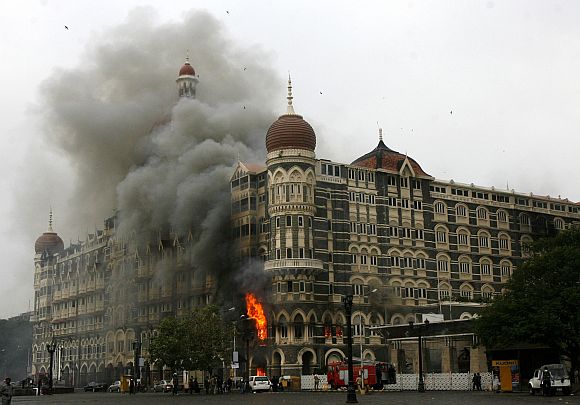
American terror suspect David Headley had also stayed at Oberoi Trident besides the Taj -- the two hotels attacked on 26/11 -- before the Mumbai carnage, reinforcing suspicion of his link with the audacious strike, according to investigators on Friday.

Testifying before a Mumbai court for the second day on Tuesday, Pakistani-American terrorist David Coleman Headley said LeT had planned to attack Indian defence scientists at the Taj Mahal Hotel in Mumbai and that he was asked by Pakistan's ISI to recruit Indian armymen to spy for them.
A request letter for access to Headley, Lashkar-e-Tayiba operative who has admitted his role in Mumbai attacks, would be sent by Home Ministry next week to the US Department of Justice, official sources said on Friday.
Days before United States President Barack Obama's maiden India visit, US envoy Timothy Roemer told CNN-IBN in an interview that the controversy over the confessions of David Coleman Headley will not affect the ties between the two countries.
Fresh details have emerged about David Headley, who was arrested by the Federal Bureau of Investigation in October for plotting terror attacks in India, with the United States media reporting that the terror suspect was born to a Pakistani diplomat father and an American mother.At the age of 16, Headley, who was born Daood Gilani, was taken out of Pakistan, where he attended a military school, and brought to Philadelphia by his mother.
The alleged Lashkar-e-Taiba operative David Coleman Headley, arrested by the Federal Bureau of Investigation for conspiring to carry out terror attacks in India, had stayed in a hotel in south Mumbai during his visit to the city, police said in Mumbai on Monday.
Senior US administration sources and law enforcement officials have told rediff.com that it was President Barack Obama's "personal interest" in the David Coleman Headley case that led to the speedy indictment of the Chicago-based Pakistan American and also the dispatching of a team to New Delhi to brief India sleuths.
The US has said it is in communication with both India and Pakistan on the case of Lashkar-e-Tayiba operatives David Coleman Headley and Tahawwur Hussain Rana, who were arrested by the Federal Bureau of Investigation in October on charges of plotting terror attacks against Indian facilities.
Interview with C D Sahay, former chief of the Research and Analysis Wing, on Headley and terror.
